Buying Montana Property From Out of State: A Complete 2026 Guide
The short answer: Paradise Valley is not one place. The corridor between Livingston and Gardiner runs more than fifty miles along the Yellowstone River, and the property you find at mile five is a different proposition than the one you find at mile thirty. Most buyers fly in for a long weekend, fall in love with a view, and write an offer before they understand the basics that govern how a Montana property actually works. This is what I would tell a friend before they came out to look.
Key Takeaways
Paradise Valley runs from Livingston south to Gardiner, and the experience of owning property here changes meaningfully every ten miles.
Senior water rights are not a paperwork detail. They determine whether your hayfield grows in August and whether your stock tank fills in February.
A “private easement” is a legal road right, not a guarantee. The county will not plow it, the neighbor will not maintain it, and the right itself can be challenged.
Wildlife on your property is not a feature you turn off. Grizzly, wolves, elk, and lions move through this corridor on routes that predate the deeds.
The community in Livingston is not the community in Pray, which is not the community in Emigrant. What gets you welcomed in one stretch will mark you as a tourist in another.
The right broker for this corridor is not necessarily the one with the prettiest website. It is the one who knows what the road looks like in February and what the river does in May.
What Most Buyers See on Their First Visit
The first visit is almost always in summer. The light is long, the river is full but no longer flooding, the cottonwoods are leafed out, and the mountains on both sides are green with stripes of snow at the top. The drive south on Highway 89 from Livingston is the most beautiful stretch of road in the lower forty-eight, and after twenty minutes most buyers have already decided they are buying something here.
That decision is rarely wrong. The valley earns its reputation. But the offer that follows is often based on a version of the corridor that exists for about ten weeks of the year. The work of being a useful broker, and the work of being a buyer who does not regret their purchase in eighteen months, is to fill in the other forty-two weeks before the contract gets signed.
What most buyers miss on the first visit is not the obvious. They notice the river, the wildlife, the open space. What they miss is structural, and structural is what determines whether a property is a good buy.
The structural pieces are water, access, wildlife, weather, and community. Every one of them looks one way in July and a different way in February, and the gap between those two pictures is the gap most buyers fall through.
This is something we explore further in virtual home tours in Montana.
How Long Is Paradise Valley and What Changes as You Move Through It?
Paradise Valley is not a town. It is a corridor of about fifty miles between Livingston in the north and Gardiner at the southern end, where Yellowstone National Park begins. Inside that corridor are several distinct stretches, each with its own character and its own set of considerations.
The northern end, near Livingston, is closer to services. You can be at a grocery store in twenty minutes, the hospital in fifteen, and the airport in Bozeman in just over an hour. Properties here tend to be smaller acreage, on the river or just off it, and the view is dominated by the Absaroka range to the east.
By the time you reach Pine Creek and Pray, about twenty miles south, the valley has narrowed and the feel has changed. You are surrounded by mountains on both sides, the population thins, and the experience starts to feel genuinely rural. The community here is small and close, the road becomes the only way in or out, and the weather can change quickly when storms come down off Emigrant Peak.
Continuing south to Emigrant and Chico Hot Springs, you are now in the heart of the valley. Property values often climb in this stretch because of the views and the proximity to the river, and because of the historical pull of Chico as a Montana cultural anchor. The drive to Livingston for groceries is forty minutes each way, which is fine in summer and less fine in a January storm.
Past Emigrant heading toward Gardiner, the corridor opens into the southern Paradise Valley. This is where the largest ranches are, where the conservation easements get most of their work done, and where the wildlife migration corridors are most intact. A property at mile thirty-five from Livingston is nearly seventy minutes from a hospital and is functionally a different kind of decision than a property at mile fifteen.
The point is that “Paradise Valley” on a listing sheet tells you almost nothing. The specific location inside the corridor tells you most of what matters.
What Do Senior Water Rights Actually Do for a Property?
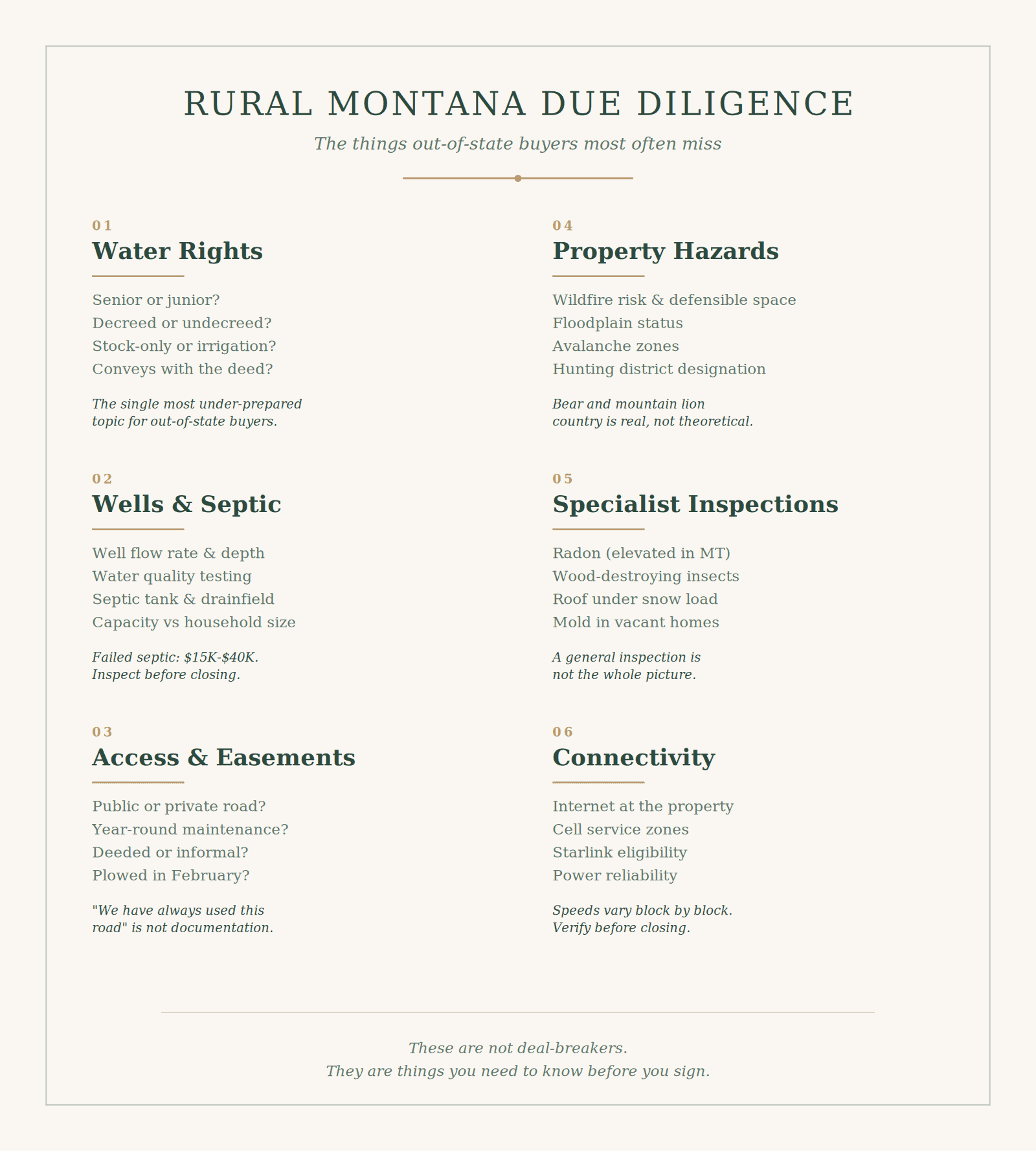
Water in Montana operates under what is called the prior appropriation doctrine. The shortest version is “first in time, first in right.” A water right with an 1885 priority date is senior to a water right with a 1965 priority date, which means in a dry year the senior right gets water first and the junior right may get nothing.
This is not abstract. In a dry summer, which the Yellowstone corridor sees often, the headgates on irrigation ditches are managed by a watermaster who shuts off junior rights to make sure senior rights get satisfied. If your property has senior water rights tied to its irrigation, your hayfield grows in August. If your property has junior rights, you may be watching your hayfield brown out while your neighbor across the road is irrigating green.
For domestic and stock water the dynamics are similar but the stakes are different. A well with a senior priority and good static level is a different asset than a shallower well with junior rights, even if both technically produce water on the day of the inspection. February is the test. If a well is going to fail or struggle, it is more likely to do so in a long cold winter than in a clear summer.
Most buyers do not know to ask about water rights specifically. They ask “is there water on the property?” and the answer is often “yes” without much detail. The real question is what the priority date is, what the historical use has been, what the consumptive use limits are, and whether the rights have been properly perfected with the Montana Department of Natural Resources and Conservation.
A buyer who walks a Paradise Valley property without asking these questions is not seeing the property the way an experienced buyer sees it. For a closer look, see buying land in Montana. Read more about this in understanding land surveys.
What Is a Private Easement and Why Does It Matter?
Many properties in Paradise Valley are accessed by private easements rather than county roads. The easement is a legal right to cross a neighboring property to reach yours, and it is what makes the property usable at all.
A private easement is a real legal interest. It runs with the land, it shows up in the title commitment, and it gives you the right to use the road. What it does not do, and this is where buyers get surprised, is obligate anyone to maintain the road or plow it in winter.
If you have a half-mile private easement to your property and the county has no role in maintaining it, you are responsible for plowing it, grading it, repairing it after spring runoff, and contributing to whatever maintenance agreement exists with the other property owners who share it. In some cases the maintenance agreement is in writing and clear. In others it is informal, and informal arrangements that worked for the previous owner may not survive the introduction of a new owner who reads the legal documents differently.
The harder version of this is the property where the easement itself is contested. A fence-line dispute, a neighbor who decides to challenge the historical use of a road, a property whose easement was granted verbally decades ago and never properly recorded. These are not rare in Montana. They are not deal-breakers either, but they require a buyer who knows to look for them and a broker who knows what to do when they show up in due diligence.
The drive in is part of the property. Walk it before you write the offer. In multiple seasons if you can.
What Should Buyers Know About Wildlife on Paradise Valley Property?
Paradise Valley sits inside the Greater Yellowstone Ecosystem, which is one of the last large intact wildlife corridors in the lower forty-eight. Grizzly bears, black bears, gray wolves, mountain lions, elk, mule deer, moose, pronghorn, and bighorn sheep all move through this valley on routes that have been used for centuries.
This is part of why people want to live here. It is also part of what makes living here different from living somewhere else. Wildlife on your property is not a feature that you turn on for guests and turn off when you want to put the trash out. Trash management, livestock protection, dog management, and basic situational awareness are part of the daily texture of life in this corridor.
A buyer with a young dog who has never lived around grizzly bears is going to learn things in their first year here. A buyer with horses or chickens or other livestock is going to think about predator pressure in a way they may not have thought about before. A buyer who likes to walk in the early morning is going to start carrying bear spray as a matter of routine.
None of this is bad. Most people who choose Paradise Valley specifically want this. But the version of the wildlife experience that shows up in listing photos is the elk grazing in a meadow at dusk. The version that does not show up is the cow elk who decides your fenced garden is the best food in the valley, or the grizzly who cleans up the bird feeder you forgot about, or the lion who is moving along the same drainage your dog likes to follow.
Properties in different parts of the valley have different wildlife profiles. A property along the river bottom has more elk and more bear pressure than a property up on a bench. A property bordering forest service land has more lion and bear traffic than one in the middle of a residential subdivision. These are not numbers on a listing sheet, but they are real differences that affect what it actually feels like to live somewhere.
What Is a Montana Winter Actually Like in Paradise Valley?
The winter most buyers prepare for is not the winter they get. There is a popular version of the Montana winter, which involves powder snow, picturesque cabins, and a fire in the fireplace. The actual Montana winter in Paradise Valley involves wind that can run hard for three days at a stretch, temperatures that swing thirty degrees in twelve hours, ice on the highway, and a level of practical preparation that most newcomers underestimate.
The 2025 to 2026 winter was unusually warm and dry. That is worth noting because the version of Montana winter buyers experienced if they came out last December is not the typical one. A normal Paradise Valley winter brings real snow accumulation, weeks of subzero temperatures in January, and a chinook wind cycle that can drop snow and then erase it within forty-eight hours.
The practical implications matter. You need a plan for power outages that can last more than a few hours. You need vehicles that can handle ice and unmaintained roads. You need backup heat that does not depend on the grid. You need to know how to deal with frozen pipes, frozen well lines, and the kind of weather that closes the only road south for the day.
These are solvable problems. People have lived in this valley for generations and most of them are fine. But solving them is part of the work, and it is part of the work that does not show up on a listing sheet. A buyer who is moving here from a place where winter means a coat and a brush for the windshield is going to want to budget time and money for the learning curve.
The summer is what makes people buy. The winter is what determines whether they stay.
How Is the Community Different in Different Parts of the Valley?
Livingston is a small city of about eight thousand people. It has a hospital, a downtown, restaurants, a working economy, and a long history as a railroad town. The community here is genuinely mixed, with multi-generation Montana families, longtime artists and writers who came in the 1970s and 1980s, working ranchers, and a steady stream of newer arrivals. The social texture is open enough that a new resident can find their way in within a year or two if they want to.
By the time you are out at Pine Creek or Pray, the social texture is different. These are small communities where people know each other by name, often over multiple generations, and where the social fabric runs through specific institutions like the volunteer fire department, the local store, the small church, or the school. A new arrival who shows up wanting things to work the way they worked in their previous town is going to take longer to find their footing than one who shows up curious and willing to participate on local terms.
Emigrant is somewhere in between. There is a real community, anchored by Chico Hot Springs and a handful of other long-running businesses, but the population is small enough and the geography spread out enough that the social rhythms are quieter. You see your neighbors at the post office and the gas station, not at a coffee shop.
What does not work in any part of this valley is showing up loud. The buyers who do well here, regardless of which stretch they choose, are the ones who arrive curious, listen for a while before they have opinions, and contribute to whatever community they have moved into. The buyers who arrive with a lot of certainty about how things should be done tend to find Montana less welcoming than they expected.
This is not unique to Paradise Valley. It is true of small communities everywhere. But it is worth saying out loud because the romantic version of moving to Montana sometimes skips the part where the community has been here a long time and has its own rhythms that are not waiting for newcomers to update them. We cover this in more detail in cost of living in Livingston.
How Should a Buyer Evaluate a Broker for This Corridor?
The right broker for Paradise Valley is not necessarily the one with the most polished website, the most listings in the Bozeman MLS, or the biggest national brand affiliation. It is the broker who actually knows the corridor, has walked specific properties in different seasons, and can tell you what a particular ditch does in May versus August.
Three questions are worth asking any broker before you decide to work with them on a Paradise Valley property:
How long have you spent in this specific corridor? Not Montana broadly. Not the Bozeman luxury market. The fifty miles between Livingston and Gardiner. A broker who works primarily in Bozeman and treats Paradise Valley as a side area is going to miss things that a broker who lives in or near the corridor will catch automatically.
What do you know about the water rights on this property? A broker who can answer this question with specifics, including priority dates and consumptive use limits, is a broker who has done the work. A broker who deflects to the title company is a broker who is going to leave water-rights problems for you to discover after closing.
What does this property look like in February? Most properties are listed in summer. The broker who can tell you what the road looks like under snow, what the wind does in this part of the valley, and what the wildlife pressure is when food gets scarce, is the broker who is going to keep you out of bad decisions.
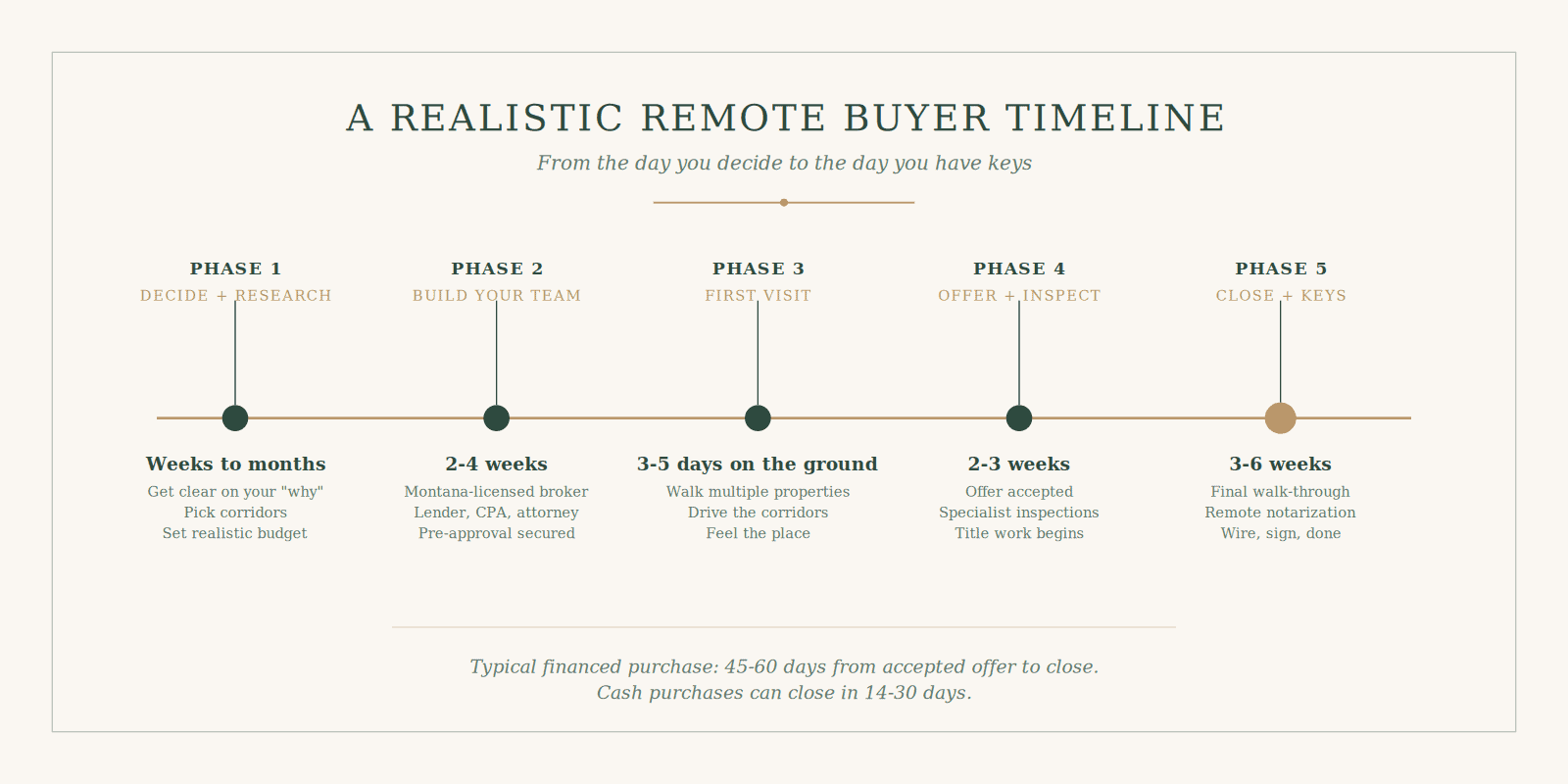
The right tools matter, and the modern technology available now makes some parts of the buying process meaningfully better. Remote due diligence, AI-assisted property research, and digital transaction infrastructure all have a real place. But the tools do not replace the broker who lives in the corridor. They make a good broker more useful. They do not turn a non-local broker into someone who knows where the elk cross the road in October.
Where Can a Paradise Valley Buyer Actually Look?
The corridor has active inventory across price points and property types. Some of it is on the major real estate platforms, some of it is local, and some of it is held by brokerages with deep specific knowledge of the area.
Legacy Lands Real Estate, based in Emigrant, represents Paradise Valley properties including the Cinnabar Basin Lodge listing in the southern part of the valley. Their inventory and corridor knowledge is a useful starting point for any buyer who is serious about this stretch of Montana. The corridor-specific guide on their site at What Buyers Should Know About Cinnabar Basin Real Estate is a thorough breakdown of one specific section of the southern valley and is worth reading regardless of which broker you ultimately work with.
For buyers looking at the broader Park County market, the resources include the standard MLS feeds, the active brokerages with corridor experience, and the public records available through the Montana Cadastral system. A buyer doing real homework will use all of them.
Frequently Asked Questions
What is the best time of year to look at property in Paradise Valley?
The best time to evaluate a property is not the best time to fall in love with it. Summer shows the corridor at its most beautiful, but spring and late fall show what the property is actually like to live with. If you are serious about a property, see it in at least two seasons before you write an offer. If that is not possible, work with a broker who can walk you through what the property looks like in the seasons you have not seen.
How much does property cost in Paradise Valley?
Prices vary widely depending on location in the corridor, acreage, water rights, river frontage, and improvements. Smaller acreage properties can start in the high six figures, while larger ranches with senior water rights and significant frontage range from several million to well over ten million. The Cinnabar Basin Lodge currently listed by Legacy Lands at $8,499,000 sits in the upper range of the corridor. The right price point depends entirely on what kind of property and what kind of life you are building.
Do I need to be a Montana resident to buy property here?
No. Out-of-state buyers purchase Paradise Valley property routinely, and there is no residency requirement to own real estate in Montana. There are tax and insurance implications worth understanding before you close, particularly if the property will be a second home or investment, and a good broker will walk you through them.
Can I close on a Paradise Valley property remotely?
Yes. Remote closings are routine, and the process can be handled through digital signing, wire transfers, and secure remote document delivery. Some buyers prefer to be present, others close from elsewhere and visit the property on a separate trip. Both approaches work.
What is the difference between Paradise Valley and Big Sky?
Big Sky is a destination resort area centered around the Big Sky resort, with significant amenity-driven property and a high concentration of vacation homes. Paradise Valley is a fifty-mile rural corridor without a resort anchor, with property that is more often used as primary residence, working land, or family retreat. The two markets are different in character, price structure, and lifestyle.
Are there conservation easements on Paradise Valley property?
Yes, and they matter. Conservation easements, often held by the Gallatin Valley Land Trust or other regional land trusts, protect significant acreage in the corridor from future development. A property under easement has different long-term implications than one without, including for resale value, tax treatment, and what you can build. This is a topic to understand thoroughly before closing on any property that has an easement on title.
Is Paradise Valley a good place for a working ranch?
Some parts of it, yes. The southern valley in particular has significant ranching history and active operations. Whether a specific property works as a working ranch depends on water rights, acreage, infrastructure, grazing carrying capacity, and the broader economics of the operation you are planning. This is not a question a listing sheet answers. It is a question that requires walking the property with someone who understands ranch operations.
A Note on Why I Live Here
This is going to sound like marketing if I am not careful, so I will keep it short and honest.
The reason I live in Paradise Valley is the same reason most people who live here live here. The corridor is one of the most beautiful places in North America, the community is real, the wildlife is intact, and the quality of life if you are willing to do the work is unmatched. There are easier places to live. There are very few places that give you back what this one does.
That is the right reason to move here. The wrong reason is the romantic version of Montana that has been sold for the last twenty years to buyers who fly in for a weekend and write a check. The buyers who do best here are the ones who are honest about what they are signing up for, who arrive with humility about how much they have to learn, and who are willing to be in the corridor long enough to understand it.
If that is the buyer you are, this is one of the best places on earth.
What to Do Next
Before you fly out to look at property, read corridor-specific guides like the Cinnabar Basin Real Estate guide on the Legacy Lands site, get a sense of which stretch of the valley fits the life you are building, and write down the questions you would ask any property: water rights, access, wildlife pressure, winter access, community.
When you arrive, try to spend more than three days. Drive the corridor end to end. Visit Livingston, Pine Creek, Pray, Emigrant, and the southern valley. Notice how each stretch feels different. Talk to people at the gas stations and the coffee shops. Stop at the Old Saloon in Emigrant. Drive the road to your prospective property in different conditions if you can.
If you would like to talk through what you are seeing, what questions are worth asking on a specific property, or what a thoughtful approach to a Paradise Valley purchase looks like for your situation, that is a conversation worth having before you write an offer rather than after.
Please contact me anytime by clicking the button below. I will get back to you within 24 hours.
Stacy Adell is a Montana real estate broker living in Paradise Valley. She holds the Accredited Buyer’s Representative (ABR) designation, the Pricing Strategy Advisor (PSA) certification, and a Propy certification for digital and crypto-enabled real estate transactions. More at stacyadell.com.
For a closer look, see the home buying process.