What a Montana Home Inspection Covers on Rural Property
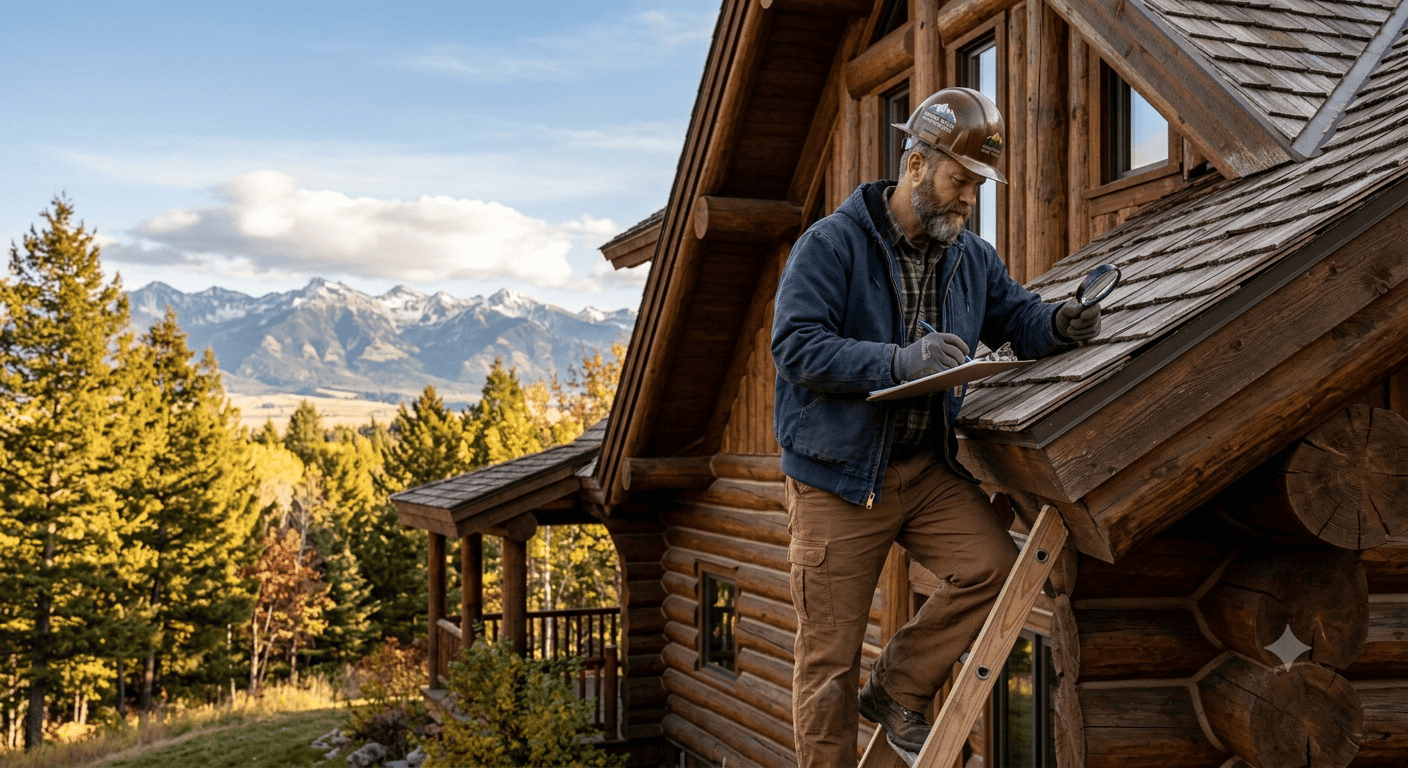
The standard report stops at the foundation. On 20 acres, that’s where the real questions start.
Short answer: A standard Montana home inspection covers the house itself: roof, structure, electrical, plumbing, HVAC, and visible components. On rural property it stops at the things that actually decide whether you can live there. The well, the septic system, radon, the access road, and any outbuildings each need their own inspection, ordered separately, often from different specialists. Budget for all of them before you waive a contingency.
When you buy a house in a subdivision, a single inspector covers most of what matters. City water comes from a meter. Sewage leaves through a public main. The road belongs to the county. On a rural Montana parcel, none of that is true, and the standard inspection report you’re handed will be quiet about exactly the systems that cost the most to fix.
This is for buyers looking at property outside Livingston, in Paradise Valley, up the Shields, or anywhere the nearest fire hydrant is a creek. By the end you’ll know what a general home inspection includes, what it skips, which specialists to add, and what the whole stack actually costs in 2026. Skipping a system to save a few hundred dollars is the most expensive mistake I watch out-of-state buyers make.
What does a standard home inspection cover, and where does it stop?
A standard home inspection is a visual, non-invasive review of the house’s accessible systems: roof, attic, foundation, framing, exterior, electrical panel, plumbing fixtures, water heater, heating and cooling, insulation, windows, and doors. The inspector reports what they can see and reach. They do not open walls, dig, or test what’s underground.
That scope is fine for the structure. The problem on rural property is everything the scope excludes by design. A general inspector will note that the water runs and the toilets flush. They will not tell you whether the well produces enough water in August, whether the septic drainfield is failing, or whether the home tests high for radon. Those are explicit carve-outs in a standard inspection agreement, not oversights.
Nationally, a standard home inspection runs about $300 to $500, with the typical price around $343 according to 2026 cost data from Angi. In rural Montana you may pay toward the higher end or add a trip charge, because the inspector is driving an hour each way to reach the property. That base fee covers the house. It does not cover the land or the systems the land depends on, and that gap is the whole point of this post.
Why does Montana’s new 2026 home inspector license matter to you?
As of January 1, 2026, home inspectors in Montana must be licensed by the Department of Labor and Industry. Before this year, anyone could print business cards and call themselves a home inspector here. The new law, passed as SB 269, sets a real floor: training, insurance, and a national association membership.
This is a meaningful change, and it’s recent enough that many buyers (and some agents) don’t know it happened yet. Under Montana Code Annotated 37-55-103, a licensed inspector must complete at least 40 hours of approved instruction, carry errors-and-omissions insurance, and belong to a recognized national inspection association. You can verify any inspector’s status through the Montana Home Inspector Program before you hire them.
My position: check the license, then ignore it. Licensing is a floor, not a recommendation. The 40-hour minimum tells you someone met a baseline, not that they understand a 1970s ranch house with a wood boiler and a spring-fed cistern. For rural work, ask how many properties on wells and septic the inspector has done, and whether they’ll walk the well house and septic lids with you, or just note “not inspected” and move on. The license filters out the obvious risks. It does not find you the right person.
What does a well inspection actually test on rural property?
A well inspection is a separate service that evaluates four things: water quantity (flow rate), water quality (lab testing), the mechanical equipment (pump, pressure tank, wiring), and the wellhead itself. A general home inspector confirms water comes out of the tap. A well inspection tells you whether it will keep coming out, and whether it’s safe to drink.
Flow rate is the number that surprises people. Measured in gallons per minute, it tells you how much water the well can sustainably deliver. The FHA treats 5 GPM as a workable minimum for a single-family home, and most residential wells run 5 to 15 GPM. Below 5, you risk running dry during heavy summer use, exactly when a Montana property is irrigating, filling stock tanks, and hosting visitors. A well that tests fine in May can struggle in late August, so ask when the flow test was done.
Water quality is the other half. Montana doesn’t require private well testing, which means it’s entirely on the buyer. MSU Extension recommends testing at minimum for coliform bacteria and nitrate, and adding arsenic, manganese, and metals at purchase. This isn’t a formality: roughly 25% of tested Montana wells show bacteria, about 3% exceed the nitrate limit, and naturally occurring arsenic or manganese sits above health thresholds in around 10% of wells. Arsenic in particular is common in parts of southwest Montana and you cannot taste, see, or smell it. The Montana DEQ water resources page is a good starting point for what’s known about local groundwater.
A full well inspection with basic water testing generally runs $350 to $550. On a property where the well is the only water source, that is the cheapest insurance you will buy all year.
What should you know about septic inspections in Park County?
Most rural Montana homes run on an onsite septic system, and it needs its own inspection, ideally one that includes pumping the tank so the inspector can see the baffles and check the drainfield. A failed drainfield is one of the more expensive surprises in rural real estate, and a visual “looks fine” without pumping tells you very little.
In Park County, onsite wastewater systems are permitted and inspected through Park County Environmental Health, which holds delegated authority under Montana DEQ. The county keeps permit records for systems installed under permit, and pulling that file tells you the system’s design, age, and size before you ever schedule an inspection. If the home predates permitting or the records are thin, treat that as a reason to inspect harder, not a reason to relax.
Two things I push buyers on. First, match the septic capacity to how you’ll actually use the house. A two-bedroom system on a home you plan to expand, or fill with guests every summer, is undersized for your life even if it passed for the prior owner. Second, ask about the drainfield’s location and condition directly, not just the tank. A real-estate septic inspection generally runs $300 to $650 according to 2026 data, and many inspectors discount it if you bundle it with the well in the same visit, often landing the pair around $400 to $650 together.
Why does radon testing matter more in Montana than almost anywhere else?
Radon is a colorless, odorless radioactive gas that seeps up from the ground into homes, and Montana has one of the worst radon profiles in the country. The EPA recommends action at 4.0 picocuries per liter. Montana’s average indoor level is 5.9 pCi/L, already above that threshold before you account for any single house.
The geography is the problem. Of Montana’s 56 counties, 49 are designated EPA Zone 1, the highest-risk category, and nearly half of Montana homes test high. This is documented through the Montana DEQ Radon Control Program and the EPA’s radon guidance. A rural home with a basement, a crawlspace, or a slab sitting on fractured Montana bedrock is a textbook candidate for elevated readings.
The good news is that radon is the cheapest serious problem to find and one of the more affordable to fix. A test during the inspection period costs very little, and a mitigation system (essentially a fan and a vent pipe) typically runs a few thousand dollars. My position is simple: test every rural property, every time, regardless of what the seller says the neighbors got. Radon varies house to house, sometimes within the same road. A clean test next door is not your test.
What rural systems get missed when you only order a standard inspection?
The well, septic, and radon are the big three, but rural Montana property carries a second tier of systems that a standard inspection won’t fully evaluate and that buyers routinely forget until something fails. These are the items that don’t show up in a subdivision and don’t appear on a generic checklist.
The list worth walking before you remove contingencies:
- Access road and easements. Who maintains the road, who plows it, and is the easement actually recorded? An unmaintained access road is a year-round expense and a winter liability. This overlaps with the title and survey work covered in how to evaluate Montana land before you make an offer.
- Wood stoves and wood boilers. Many rural homes heat with wood. A WETT-style inspection of the stove, chimney, and clearances is worth ordering separately, both for safety and because your insurer may require it.
- Propane and fuel systems. Owned versus leased tank, age, and placement. A leased tank ties you to one supplier.
- Outbuildings. Barns, shops, and well houses are usually excluded from the main inspection. If a structure has value to you, inspect it.
- Spring boxes and cisterns. Some older properties use a spring rather than a drilled well. That’s a different system with different risks, and it needs someone who understands it.
- Floodplain and drainage. Property along the Yellowstone or a tributary may sit partly in a mapped floodplain, which affects insurance and buildability.
None of these are deal-killers on their own. The danger is discovering them after closing, when they become your problem instead of a negotiation point.
How much should you budget for inspecting a rural Montana property?
Plan for a stack of inspections, not one. On a typical rural Montana home, expect the base home inspection plus a well inspection, a septic inspection, and a radon test, with optional add-ons for wood-burning appliances and outbuildings. Realistically, that’s roughly $900 to $1,800 all in, depending on property size and how far inspectors travel.
Here’s how the core pieces break down in 2026:
| Inspection | Typical 2026 cost | Who performs it |
|---|---|---|
| Standard home inspection | $300 to $500 | Licensed home inspector |
| Well inspection + basic water testing | $350 to $550 | Well specialist or qualified inspector |
| Septic inspection (real estate) | $300 to $650 | Septic company or county-qualified inspector |
| Radon test | $100 to $250 | Inspector or radon professional |
| Well + septic bundled | $400 to $650 | Same provider, same visit |
Costs vary widely by property, and that’s not a hedge, it’s the reality of rural land. A well on one parcel is 80 feet deep with easy access; on the next it’s 400 feet down a rough two-track. Septic costs swing with system size, age, and whether the tank can be located at all. Treat these ranges as a starting point and confirm current pricing with local providers, because a single hour-plus drive can change every quote.
Set against the price of the property and the cost of a failed drainfield or a dry well, the full inspection stack is not where you economize. It’s the part of the transaction that tells you what you’re actually buying. The same logic applies to understanding property taxes before you buy: the goal is no expensive surprises after closing.
What would I actually tell a buyer to do?
If you remember one thing, remember that the standard inspection is the beginning of due diligence on rural property, not the end of it. The house is the easy part. The systems that make the house livable, water in, waste out, air safe to breathe, road open in February, are the part that decides whether this property works for your life.
So order the full stack. Verify your inspector’s new Montana license, then hire on rural experience rather than the license alone. Pull the county septic and well records before you inspect. Test for radon every single time. And write your contingency period long enough that you can actually get specialists out to a property that might be an hour from town, because the good ones are booked and the drive is real.
Get those right and the inspection period does its job: it turns an emotional decision about a beautiful piece of Montana into a clear-eyed one about what you’re taking on. That’s the whole point of doing it well.
Stacy Bennin is a licensed real estate broker in Montana, affiliated with Legacy Lands Real Estate in Paradise Valley. She helps buyers and sellers across Park County and southwest Montana find property that fits their needs, and stays current on AI and emerging technology so her clients benefit from where real estate is headed, not just where it has been. Reach her at stacyadell.com or (406) 224-3267.